> For the complete documentation index, see [llms.txt](https://support.onlogic.com/llms.txt). Markdown versions of documentation pages are available by appending `.md` to page URLs; this page is available as [Markdown](https://support.onlogic.com/product-documentation/rugged-products/rugged-by-neousys/poc-500-series.md).
# POC-500 Series
### Manual, Driver, Datasheet
As a certified OnLogic solution, all detailed product documentation, including user manuals, technical specifications, regulatory information, and software downloads, is available directly on the manufacturer support site linked below.
{% embed url="" %}
### Enabling Auto Power On
The auto power on feature will turn the POC-500 system back on after a power loss. This can be useful for automatic recovery after a power outage, or applications where the system’s power button is not easily accessible.
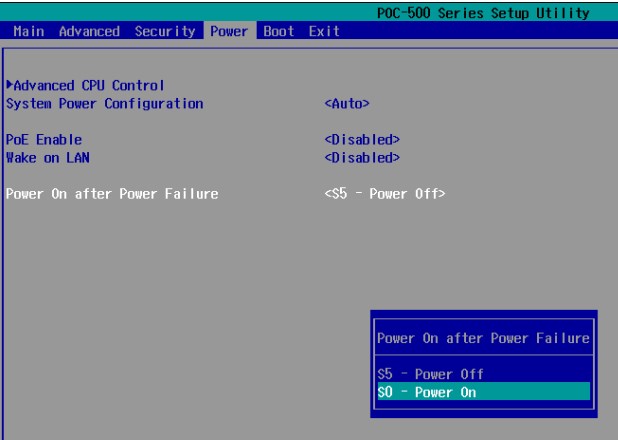
1. Power on the unit and immediately press the F2 key a few times to access the BIOS.
2. Navigate to the Power tab.
3. Change the “Power On after Power Failure” option to “S0-Power On”
4. Navigate to the Exit tab.
5. Save Changes and Exit.
6. The unit will now automatically power on when power is connected.
### Disassembly and clearing the CMOS
If the system fails to power on or is otherwise unresponsive, clearing the CMOS may help. It will also restore the BIOS to factory defaults.
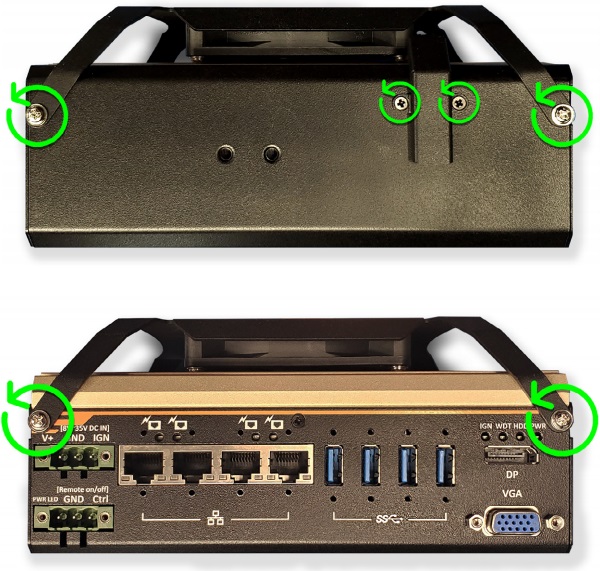
* If equipped with an external fan, remove the screws shown.
* Unplug the fan connector and set the fan aside
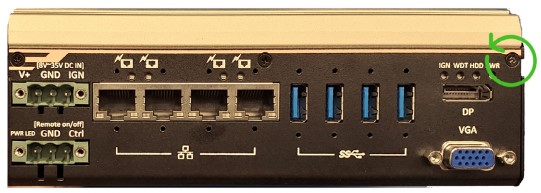
* Remove the screw shown
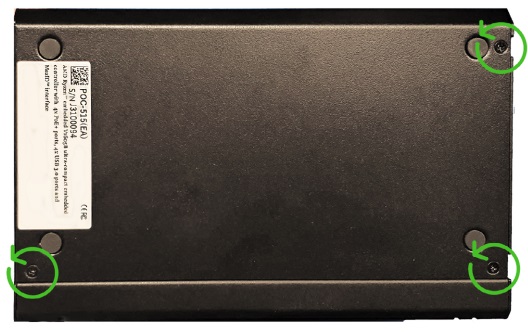
* Remove the screws shown
* Slide the bottom plate off.
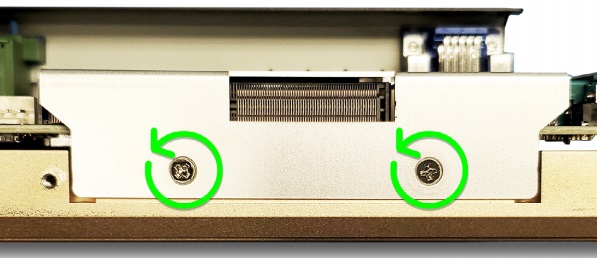
* Remove the two screws in the RAM heat-spreader.
* Pull the heat-spreader off
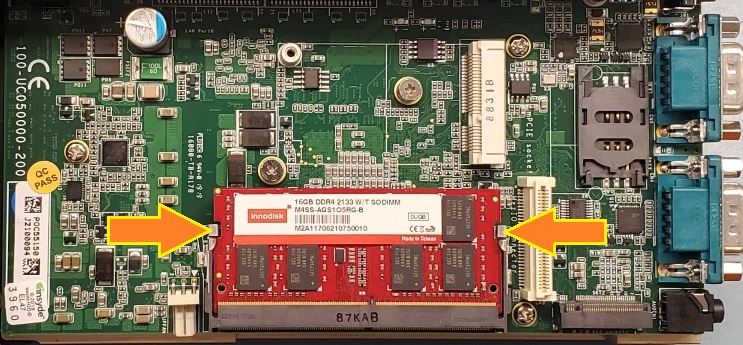
* Remove the RAM by gently pressing the two metal clips outward away from the RAM.
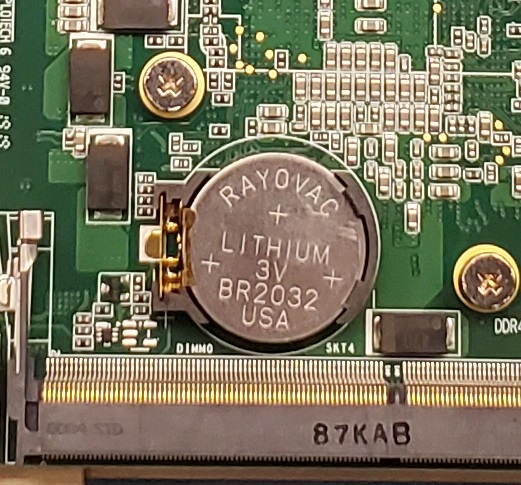
* Remove the coin cell battery.
* Leave the battery out of the system for 5 minutes and then reinstall it.
* The CMOS has now been cleared. The system may reboot several times to reconfigure itself. Be patient when powering it back on.